
The Tricycle Model: Balancing the Journey of Holistic Learning
You step into class and within minutes, the ride feels unsteady. One learner is eager but unfocused, another is quiet and withdrawn, and a third needs movement, yet the timetable says sit still. However well you plan, progress is often jolted because one part of learning is doing all the work while another is left behind—a problem the Tricycle Model in education is designed to address.
The Tricycle Model steadies that ride. Like any tricycle, balance is achieved when emotions and attitudes (affective), hands-on tasks (psychomotor), and thinking and knowledge (cognitive) work together. Holistic education has long urged us to develop the whole person—identity and belonging, agency and collaboration, curiosity and understanding—rather than pedal on grades alone UNESCO, 2021; OECD, 2021.
Why the Tricycle Model Matters Now
After the disruption of the pandemic, schools are once again under strain. In the UK, full-time teachers typically work 51.2 hours each week, with school leaders working even more — a figure that exceeds prescribed working limits and puts strain on wellbeing National Education Union+1.
The Teacher Wellbeing Index 2024 shows that 78% of UK education staff report that their working environment negatively affects their mental health, with many experiencing symptoms such as insomnia, anxiety, and emotional exhaustion The Guardian+11Education Support+11Amhie+11.
Meanwhile, the OECD’s 2024 analysis of social and emotional learning (SEL) highlights that in countries where SEL is prioritised, student engagement, motivation, and resilience show significant improvement OECD+8OECD+8OECD+8.
Together, this evidence makes one point clear: when education focuses solely on academic outcomes without nurturing emotional and practical dimensions, the entire system — and the people within it — becomes unbalanced.
The Tricycle Explained
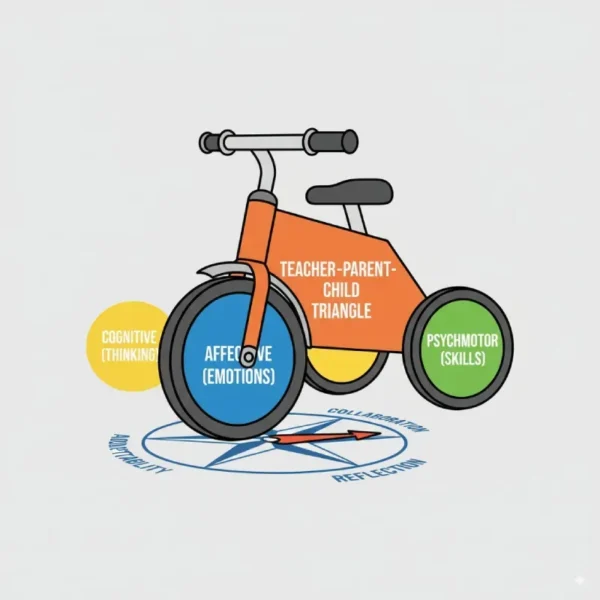
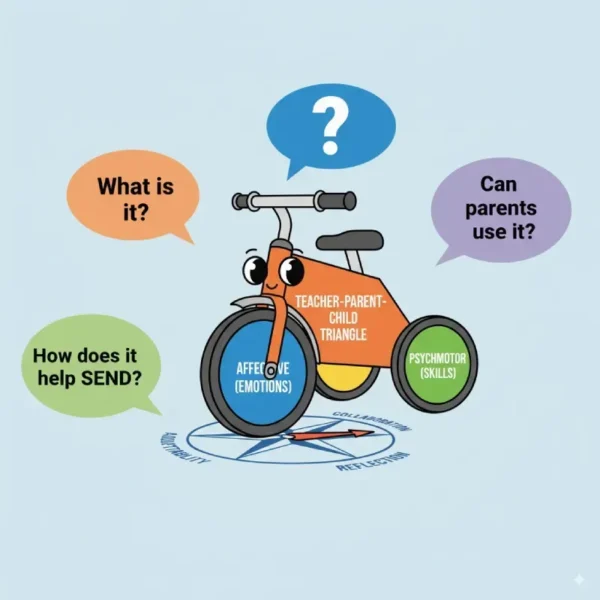
The Tricycle Model rests on a simple but powerful metaphor: learning, like riding a tricycle, needs balance, direction, and support. Each of the three wheels represents one of the core domains of holistic education:
Affective wheel → emotions, attitudes, values, and motivation Krathwohl et al., 1964
Psychomotor wheel → applying skills through doing, movement, and practice Simpson, 1972
- Cognitive wheel → knowledge, reasoning, and critical thinking Bloom, 1956
When one wheel is underdeveloped, the learning journey becomes unstable. For example, a pupil may excel in theory (cognitive) but lack confidence (affective), or show enthusiasm without the practical skills to act on it (psychomotor). Actual progress requires all three wheels to turn together OECD, 2023
The frame of the tricycle symbolises the teacher–parent–child partnership. Without a solid frame, learning falters. This reflects Bronfenbrenner’s ecological systems theory, which emphasises how relationships among home, school, and community shape development Bronfenbrenner, 2005
Every journey also needs direction. The Tricycle’s compass is guided by four principles: Collaboration, Inclusivity, Adaptability, and Reflection. These values ensure that education not only advances, but also advances wisely UNESCO, 2025
Consider a Year 6 teacher in East London. Her class achieved well in exams but felt disengaged. By introducing reflective journals (affective), hands-on science projects (psychomotor), and discussion-based lessons (cognitive), she created a classroom that was not only high-achieving but also motivated and cooperative. The imbalance had been corrected — the learning journey became steady once more.
Holistic Education & Global Alignment
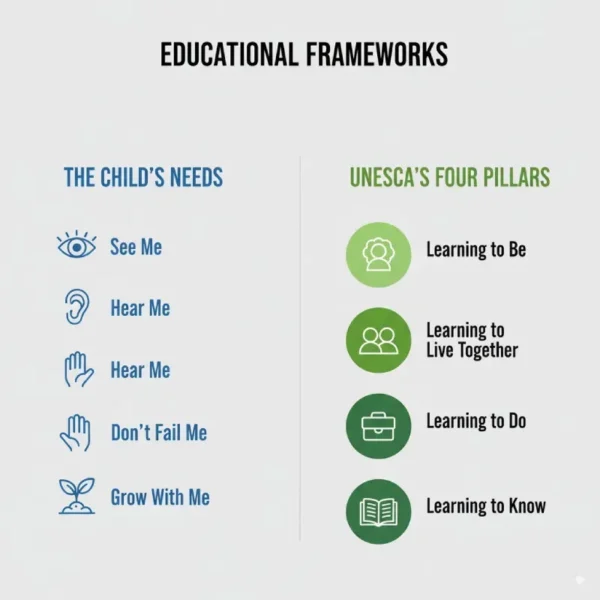
Holistic education is not a new concept, but its urgency has intensified in recent years. Global frameworks now emphasize that schools must support identity, belonging, collaboration, adaptability, and lifelong learning — not just measure performance through tests (UNESCO, 2021; OECD, 2024). The Tricycle Model aligns directly with this conversation, translating broad goals into practical classroom applications.
Your guiding tagline — “See me, hear me, do not fail me, grow with me” — aligns powerfully with UNESCO’s Four Pillars of Learning (Delors, 1996; UNESCO, 2021):
Tagline Principle | UNESCO Pillar | Focus |
See Me | Learning to Be | Identity, belonging, emotional recognition |
Hear Me | Learning to Live Together | Voice, agency, respectful collaboration |
Do not Fail Me | Learning to Do | Skills, adaptability, real-world application |
Grow With Me | Learning to Know | Curiosity, lifelong learning, critical inquiry |
This mapping illustrates how the Tricycle supports learners’ journeys in Birmingham, Nairobi, and Singapore alike. By connecting emotions, skills, and knowledge with shared international principles, the Tricycle offers a classroom-ready framework rooted in global aspirations (UNESCO, 2021; OECD, 2024).
In practice, this means:
- Valuing students’ stories (See Me)
- Amplifying their voice (Hear Me)
- Equipping them with adaptable skills (Do not Fail Me)
- Nurturing a curiosity that lasts a lifetime (Grow With Me)
If you’d like, I can also draft an APA-style References section with these sources and tidy link titles, ready to paste at the bottom of your blog post. Let me know if you’d like me to prepare that too!
Practical Application: Riding the Tricycle in Classrooms
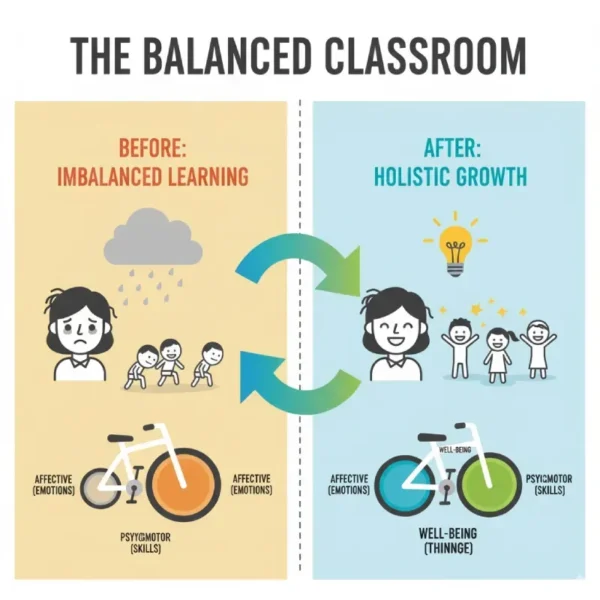
A framework only matters if it works in practice. The Tricycle Model provides straightforward, practical approaches for teachers, parents, and students to restore balance in everyday learning.
Structured tools make this possible:
- The Tricycle Self-Audit Worksheet helps teachers reflect on whether lessons balance emotions, skills, and knowledge.
- The Triangle Reflection Sheet invites teachers, parents, and pupils to strengthen the learning “frame” through shared dialogue.
- Classroom activities like Balance the Wheels encourage pupils to connect feelings, actions, and thinking in one task.
These reflective and participatory approaches align with research indicating that balanced learning environments enhance engagement and achievement (Hattie, 2023).
For learners with special educational needs or disabilities (SEND), balance is especially crucial. A child with dyslexia may thrive in hands-on experiments (doing) but lose confidence if reading tasks dominate (thinking). Pupils with ADHD often need strong emotional support—such as encouragement and peer collaboration—before their learning steadies (DfE, 2023). Minor adjustments, such as multi-sensory resources, movement breaks, and cooperative group work, can make a significant difference (Florian & Black-Hawkins, 2023).
Case studies show the Tricycle in action:
- In urban London, a teacher reduced stress and lifted motivation by using weekly self-audits.
- In rural India, low-cost science kits gave children practical skills to complement literacy.
- In Dubai and Singapore, multilingual reflection sheets bridged home–school expectations and promoted inclusion.
Together, these examples demonstrate the Tricycle in action: before, classrooms faced disengagement and stress; after, they found a steadier balance and a clearer sense of shared purpose (UNESCO, 2025).
Voices from Practice
Teacher perspective
“Using the Tricycle Self-Audit took me less than 10 minutes, but it completely changed how I planned the next lesson. It showed me which ‘wheel’ I’d overlooked and helped me restore balance for my class.”
Parent perspective
“The Triangle Reflection Sheet gave me a real say in my child’s learning. For the first time, I felt like we were truly pulling together as teacher, parent, and child.”
Student perspective
“I liked the Balance the Wheels activity because I could draw how I felt, not just write. It made me think about what I learned in a new way.”
Global Relevance & Adaptability
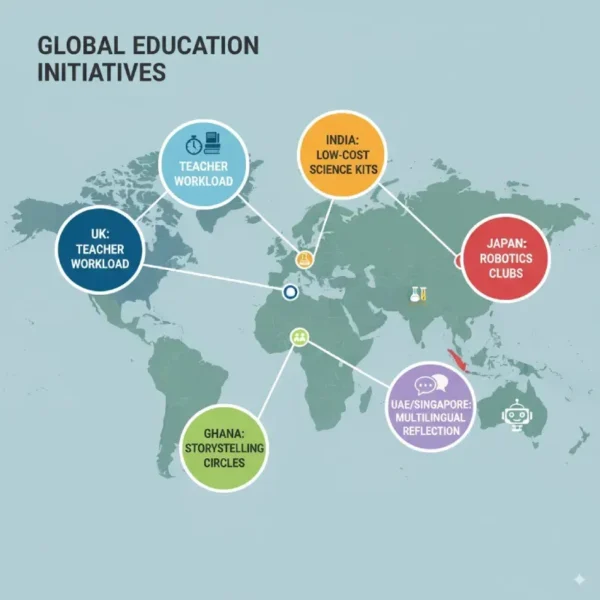
One of the Tricycle Model’s greatest strengths is its ability to adapt across cultures and contexts. Just as a tricycle can be ridden on many terrains, the model steadies learning in classrooms from Birmingham to Nairobi, Karachi to Singapore.
In the UK, where accountability pressures often prompt teachers to adopt test-driven practices, the Tricycle serves as a reminder to strike a balance between performance, wellbeing, and skill development (DfE, 2024).
In South Asia and Africa, where resources are limited, it shows that creativity, storytelling, and community partnerships can keep all three wheels turning—even without expensive tools (UNESCO, 2025).
In international schools in Dubai and Singapore, diverse student populations benefit from the Tricycle’s shared language of balance, which transcends cultural differences (OECD, 2024).
Cultural adaptations bring the model to life:
- In Ghana, storytelling circles strengthen the affective wheel by building belonging and values.
- In Japan, robotics clubs sharpen the psychomotor wheel while reinforcing cognitive skills.
The guiding compass—Collaboration, Inclusivity, Adaptability, and Reflection—allows schools to adjust the model without losing its integrity (UNESCO, 2021).
This global flexibility shows that the Tricycle is more than a metaphor. It is a universal framework for holistic education, prepared to address the diverse challenges of the 21st century.
From Wobble to Balance: Real Stories and Practical Steps
A Case from Birmingham
In a Year 5 class in Birmingham, a teacher noticed her pupils were enthusiastic during science experiments but struggled to explain the concepts behind them. Their psychomotor wheel (doing) was strong, but the cognitive wheel (thinking) lagged. By introducing short reflection journals at the end of lessons, pupils began connecting their actions to explanations: “I saw the shadow move when I moved the torch.” Within weeks, test results and class discussions showed clearer reasoning. The wobble had been steadied, not by extra content, but by balancing action with thought.
Quick “How-To” Scenarios
- Year 4 History – Ancient Egypt
- Start (5 mins): Ask pupils to draw how they felt when exploring artefacts (affective).
- Middle (10 mins): Have them build or sketch a pyramid model (psychomotor).
- End (5 mins): Pair-share one new fact or question about pharaohs (cognitive).
➡ Outcome: All three wheels turn in a single 20-minute activity.
- Year 7 English – Poetry Lesson
- Feelings: Begin with a quick “emoji card” check-in — how does the poem make you feel?
- Doing: Pupils highlight or annotate key lines.
- Thinking: Small groups discuss what the poet might be saying about identity.
➡ Outcome: Emotional connection builds confidence before tackling abstract meaning.
- Year 10 Maths – Geometry
- Feelings: Ask, “How confident do you feel about today’s problem?” (traffic-light cards).
- Doing: Pupils solve a shape problem in pairs on mini-whiteboards.
Thinking: They explain their reasoning step-by-step to another pair.
➡ Outcome: Quick cycle that steadies confidence, practice, and reasoning together.
FAQs: The Tricycle Model in Education
- What is the Tricycle Model in education?
The Tricycle Model is a holistic framework that balances three domains of learning:
- Affective (emotions and attitudes)
- Psychomotor (skills and doing)
- Cognitive (knowledge and thinking)
Just like a real tricycle, all three wheels must move together for stability. If one wheel wobbles, learning feels unsteady (Anderson & Krathwohl, 2001).
- How does the Tricycle Model support SEND and inclusion?
Balance is essential for pupils with special educational needs and disabilities (SEND). The Tricycle encourages teachers to adapt lessons with:
- Multi-sensory activities (visual, auditory, tactile)
- Collaborative and peer-support tasks
- Emotional scaffolding to build confidence
These adjustments create inclusive classrooms where every learner participates meaningfully (Florian & Black-Hawkins, 2023; DfE, 2023).
- How does the Tricycle Model connect with SEL and Growth Mindset?
The Tricycle’s affective wheel aligns directly with social and emotional learning (SEL), nurturing self-awareness, resilience, and motivation (OECD, 2024). It also supports Growth Mindset thinking, where pupils view effort and practice as pathways to progress, rather than signs of failure (Dweck, 2019). - Is the Tricycle Model only for teachers, or can parents use it too?
Parents are part of the Tricycle’s “frame” — the teacher–parent–child triangle. Reflection sheets and home–school conversations provide parents with an opportunity to play a role in strengthening their child’s motivation, skills, and knowledge. This consistency between classroom and home helps create a steady, supportive learning environment (Bronfenbrenner, 2005). - How does the Tricycle differ from other models like UDL or CASEL SEL?
The Tricycle shares common goals with Universal Design for Learning (UDL) and CASEL’s SEL framework, but its strength lies in simplicity. The metaphor of a tricycle makes the idea of balance accessible, visual, and memorable. Teachers, parents, and pupils can all grasp and apply it in daily practice (CAST, 2018; CASEL, 2020).
Call to Action
Every classroom has its wobble. Sometimes it shows in pupil disengagement, sometimes in teacher burnout, and sometimes in the quiet frustration of parents who feel left out. The Tricycle Model offers a way to restore balance — but like any ride, it begins with a single push.
So here is the invitation: reflect on your own practice. Where does your Tricycle wobble most — Feelings, Doing, or Thinking? Share your thoughts in the comments, or start a conversation with colleagues and parents.
Free Resource: To help you get started, we have created the Tricycle Toolkit — including a quick 5-minute Self-Audit Tool and ready-to-use worksheets for teachers, parents, and pupils. [Download your free Toolkit here] and see how it shifts the balance in your classroom.
If this framework resonates, take the next step and explore the 3A’s of Learning — a companion model that unpacks Atmosphere, Attitude, and Action. Together, the Tricycle and the 3A’s form a powerful cycle of growth, ensuring no learner is left wobbling on two wheels alone.
Get the Tricycle Model Self-Audit Tool
Free PDF to balance feelings, thinking and doing in your classroom.
Reference
- Anderson, L. W., & Krathwohl, D. R. (Eds.). (2001). A taxonomy for learning, teaching, and assessing: A revision of Bloom’s taxonomy of educational objectives. Longman.
- Bloom, B. S. (Ed.). (1956). Taxonomy of educational objectives: The classification of educational goals. Handbook I: Cognitive domain. David McKay.
- Bronfenbrenner, U. (2005). Making human beings human: Bioecological perspectives on human development. SAGE.
- CASEL. (2020). What is SEL?. Collaborative for Academic, Social, and Emotional Learning. https://casel.org
- CAST. (2018). Universal Design for Learning guidelines version 2.2. CAST. http://udlguidelines.cast.org
- Delors, J. (1996). Learning: The treasure within. UNESCO Publishing.
- Department for Education. (2023). Special Educational Needs and Disability (SEND) Code of Practice: 0 to 25 Years. UK Government.
- Department for Education. (2024). Teacher Workforce in State-Funded Schools, England: 2024 Update. UK Government.
- Dweck, C. S. (2019). Mindset: Changing the way you think to fulfil your potential (Updated ed.). Robinson.
- Education Support. (2024). Teacher Wellbeing Index 2024. Education Support.
- Florian, L., & Black-Hawkins, K. (2023). Exploring inclusive pedagogy. Routledge.
- Hattie, J. (2023). Visible learning: The sequel. Routledge.
- Krathwohl, D. R., Bloom, B. S., & Masia, B. B. (1964). Taxonomy of educational objectives: The classification of educational goals. Handbook II: Affective domain. David McKay.
- National Education Union. (2025). State of education: Teacher stress and wellbeing. NEU.
- Organisation for Economic Co-operation and Development. (2023). Education at a glance 2023: OECD indicators. OECD Publishing. https://doi.org/10.1787/69096873-en
- Organisation for Economic Co-operation and Development. (2024). Nurturing social and emotional learning across the globe: Findings from the OECD Survey on Social and Emotional Skills 2023. OECD Publishing. https://doi.org/10.1787/32b647d0-en
- Simpson, E. J. (1972). The classification of educational objectives in the psychomotor domain. Gryphon House.
- UNESCO. (2021). Reimagining our futures together: A new social contract for education. UNESCO Publishing.
- UNESCO. (2025). Learning for all: Global report on student engagement and wellbeing. UNESCO Publishing. https://unesdoc.unesco.org
I really like the Tricycle Model. It makes learning feel balanced between feelings, thinking, and doing. It is easy to understand and useful for teachers and students.